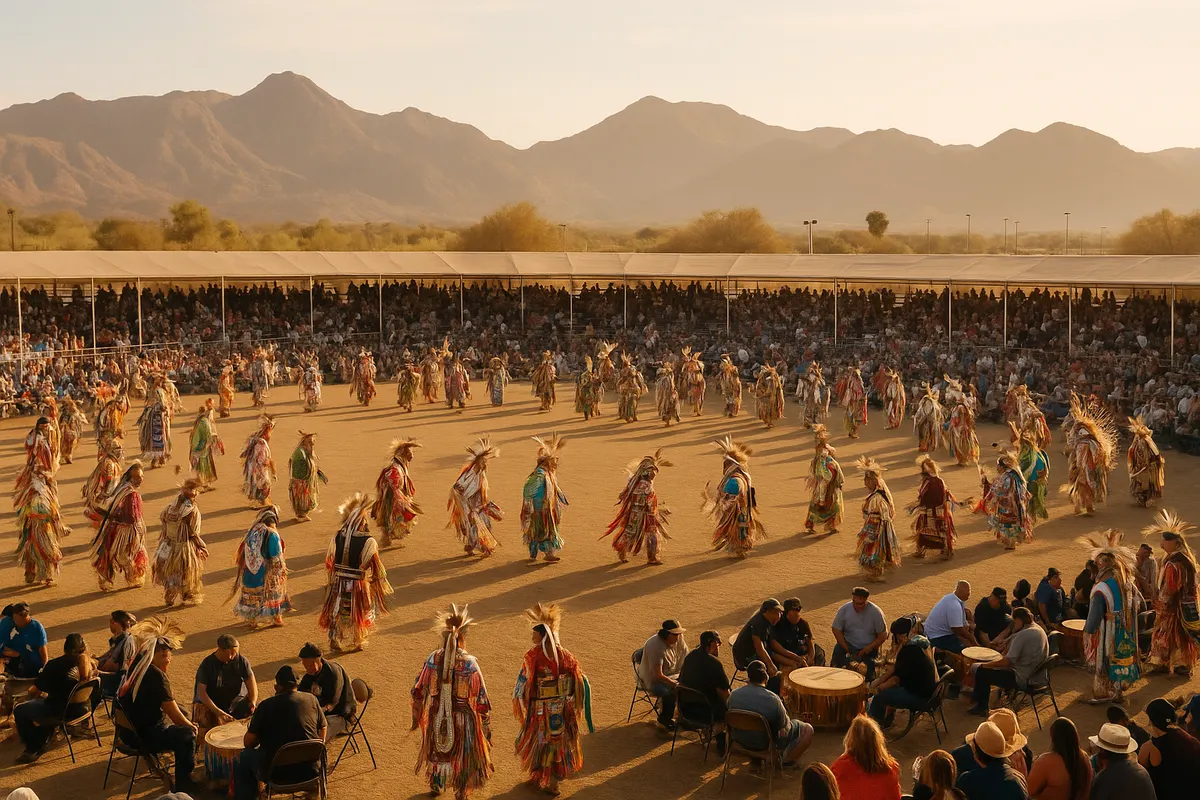
A powwow hosted by a casino tribe is not a casino promotion. That is the first thing to get straight, because the reflex in this industry is to read every community event as marketing spend with a cultural veneer. The 35th Annual Morongo Thunder & Lightning Powwow, held September 25–27 at the Morongo powwow grounds near Morongo Casino Resort & Spa in Cabazon, California, drew more than 30,000 spectators and charged nobody a penny to get in. That combination, huge attendance and zero gate revenue, is the clearest single window into tribal gaming culture you will find: gaming pays for the infrastructure, and the culture is the point of the exercise, not the product being sold.
The scale of the 35th Morongo powwow, in numbers
The event opened on California Native American Day and ran three days. More than 900 dancers and 20 drum groups travelled from across the United States and Canada to compete and perform. Alongside the dance arena, the Morongo Indian Market hosted over 115 vendors selling handmade baskets, beadwork, clothing, jewellery and pottery, with food stalls serving Indian tacos and frybread.
| Detail | Figure |
|---|---|
| Edition | 35th annual |
| Dates | September 25–27 |
| Location | Morongo powwow grounds, near Morongo Casino Resort & Spa, Cabazon, California |
| Attendance | More than 30,000 |
| Dancers | More than 900 |
| Drum groups | 20, from the U.S. and Canada |
| Indian Market vendors | More than 115 |
| Admission | Free |
For context on what those numbers mean operationally: a free three-day event for 30,000 people needs parking, sanitation, security, medical cover, staging, sound, prize money for dance and drum competitions, and a vendor village. None of that is cheap, and none of it is recovered at the gate. A tribe with a functioning gaming enterprise can absorb that cost. A tribe without one generally cannot, which is why the economics of the event and the economics of the casino are not separable.
What the money is legally for
Under the Indian Gaming Regulatory Act of 1988, net revenues from tribal gaming cannot simply be distributed as profit the way a commercial operator distributes to shareholders. IGRA restricts their use to a defined set of purposes: funding tribal government operations and programs, providing for the general welfare of the tribe and its members, promoting tribal economic development, donating to charitable organisations, and helping fund operations of local government agencies. Per capita payments to members are permitted only under an approved revenue allocation plan. Tribal gaming operations are regulated by tribal gaming commissions alongside the National Indian Gaming Commission, and in California by compacts negotiated with the state.
That legal structure is why the phrase “gaming revenue impact” means something different in Indian Country than it does in Las Vegas or Macau. Cultural preservation, language programs, youth programs and events like a powwow sit squarely inside “general welfare of the tribe.” The revenue does not fund culture as a side project. Funding it is one of the statutory reasons the revenue exists.
The Morongo Band of Mission Indians, which operates Morongo Casino Resort & Spa in Southern California, is one of the more established gaming tribes in the state. Thirty-five consecutive editions of a powwow is a long-run commitment that predates and outlasts any single marketing cycle.
The cultural content, and why the detail matters
The daily centrepiece was the Grand Entry, when hundreds of dancers in handcrafted regalia of leather, fine beadwork and feathers entered the arena together, men, women and children, to the drum groups and singers. Competitions ran across a range of dance styles from across North America.
Two elements were specifically local. Bird singing, the song cycles passed down through generations among Southern California tribes, and peon, a traditional team guessing game long played by the Morongo Band and neighbouring tribes. Peon is worth pausing on for an industry audience: wagering games are not something that arrived in Southern California with slot machines in the 1980s. Games of chance and skill played between teams and families are part of the older cultural record. The modern casino is a regulated commercial layer on top of a much longer relationship with gaming.
Tribal Chairman Charles Martin framed the purpose directly: “The Morongo Powwow allows us to share Native American culture and heritage with guests from across the globe. At its heart, the Thunder & Lightning Powwow is about renewing our commitment to our traditions and about making sure our culture, our heritage and our values continue to live on through our young people.”
Note what is absent from that statement. No footfall target, no database sign-ups, no cross-sell to the casino floor. The stated objective is intergenerational transmission.
Why iGaming readers should care
Three practical reasons, and none of them are sentimental.
- Tribes are counterparties, not just venues. Any operator, supplier or sportsbook negotiating with a gaming tribe in the United States is negotiating with a sovereign government that has statutory obligations to its members and a community mandate attached to every revenue stream. Deal terms that would be routine with a commercial operator, aggressive revenue splits, brand takeovers, data ownership, land in tribal hands on long horizons, get read through that lens.
- It explains the pace on digital. Tribal caution about online expansion, particularly in California, is frequently misread as technophobia or protectionism. It is more accurately read as risk management around an asset that funds government services, healthcare, education and cultural programs. When a revenue base carries that load, you do not cannibalise it for a channel whose regulatory treatment of exclusivity is unsettled.
- It sets a standard for what community investment looks like. Cultural events run by casinos across the commercial sector are often activation budgets. A 35-year-old free festival with 900 competing dancers is a different category of commitment, and it is the benchmark local stakeholders and legislators will increasingly cite when operators talk about giving back.
The honest read on the link between casinos and culture
Gaming revenue is not a moral good in itself. A casino makes money because every game carries a house edge, the mathematical difference between what a game returns to players over the long run and the total wagered. That edge is the funding mechanism, and pretending otherwise does nobody any favours. What tribal gaming does, by statute and in practice, is route that margin into tribal government, community services and heritage work rather than into private dividends alone.
Thirty thousand people watching Bird Singing on the powwow grounds at Cabazon is what that routing looks like when it works. It is a more useful measure of a tribal casino community than any quarterly revenue line, and a fairer answer to the question of what the industry actually leaves behind.
FAQ
What is the Morongo powwow?
The Morongo Thunder & Lightning Powwow is an annual Native American cultural festival held at the Morongo powwow grounds near Morongo Casino Resort & Spa in Cabazon, California. The 35th edition ran September 25–27, drew more than 30,000 spectators, and featured over 900 dancers and 20 drum groups from the U.S. and Canada. Admission was free.
How does tribal gaming revenue support cultural events?
The Indian Gaming Regulatory Act limits the use of net tribal gaming revenues to purposes including tribal government operations, the general welfare of the tribe, economic development, charitable giving and support for local government. Cultural and heritage programs fall within those permitted uses, so events like the powwow can be funded and offered free of charge.
Do powwows involve gambling?
No. A powwow is a music, dance and art gathering. The Morongo event did include peon, a traditional team guessing game of Southern California tribes, presented as cultural practice rather than as a commercial gaming product.
Why do tribes keep admission free?
Free admission fits the stated purpose of sharing culture and passing traditions to younger generations rather than generating ticket income. It is viable because a tribe with gaming revenue can carry the operating cost of the event.
If you gamble, treat it as paid entertainment with a built-in house edge, set deposit and time limits before you play, and use self-exclusion or cool-off tools if play stops feeling like a choice. Support is available through national problem gambling helplines.