What Amusnet actually did in Greece
Ever wondered how a slot cabinet ends up bolted to a casino floor in Thessaloniki? It is rarely a sales call and a delivery van. The Amusnet Greece land-based launch is a useful worked example, because the press release is short and the process behind it is long.
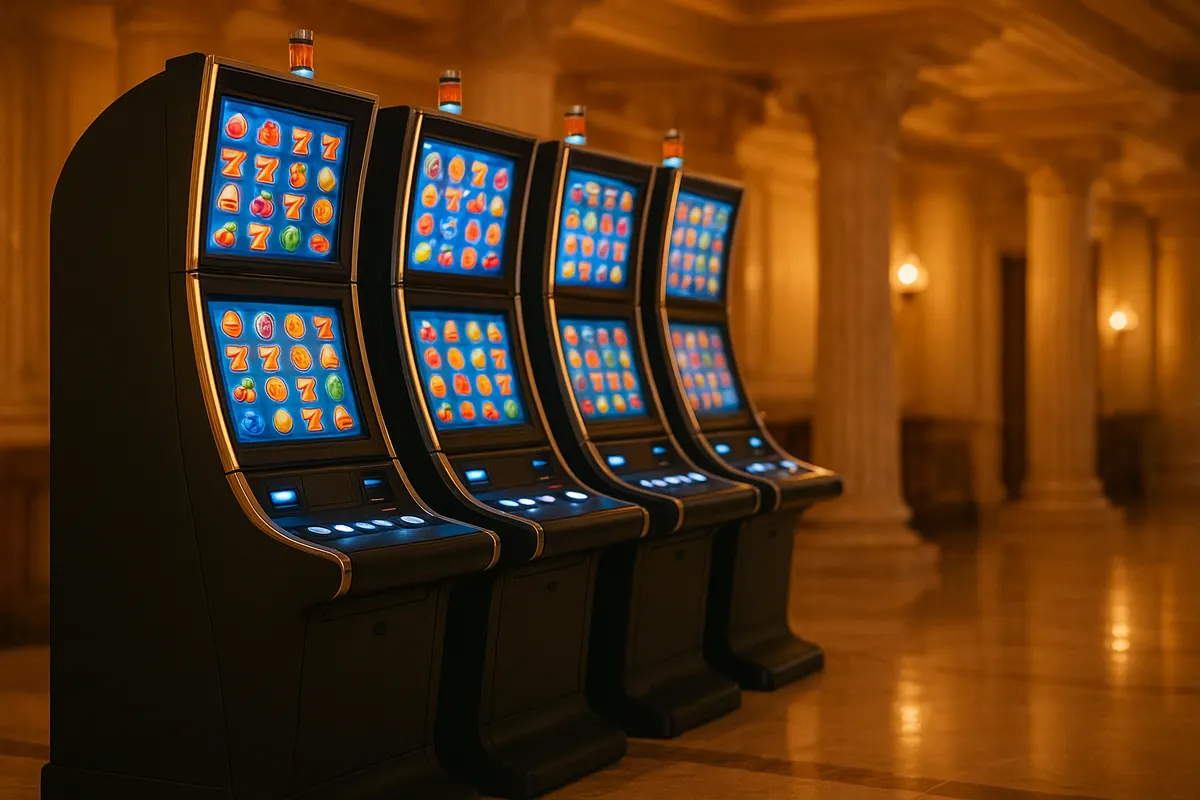
The facts, as reported by G3 Newswire: Amusnet has completed its first land-based slot machine installations in Greece, across four of the country’s best-known casinos. Type S 55J cabinets went into Regency Casino Thessaloniki and Regency Casino Mont Parnes. Type S 50F cabinets went into Casino Rodos and Casino Corfu. Jelena Stankovic, Director at Amusnet, framed it as an expansion of the company’s existing Greek footprint and part of an ambition to become a leading supplier in the country, across both online and land-based gaming.
| Casino | Location | Cabinet model |
|---|---|---|
| Regency Casino Thessaloniki | Thessaloniki | Type S 55J |
| Regency Casino Mont Parnes | Attica (Mount Parnitha) | Type S 55J |
| Casino Rodos | Rhodes | Type S 50F |
| Casino Corfu | Corfu | Type S 50F |
Two details are worth pausing on. First, Amusnet was already active in the Greek online market, so this is a segment expansion rather than a cold start in an unfamiliar territory. Second, the rollout is small and concentrated: four venues, two cabinet types. That is what a first install normally looks like. Nobody sensible ships hundreds of machines into a new jurisdiction before the first batch has proven itself on the floor.
How slot providers enter new regulated markets, step by step
The order varies by country, but the sequence below is close to universal for a regulated land-based market. Treat it as the general playbook rather than a description of any one jurisdiction’s paperwork.
1. Decide whether the market is worth the paperwork
Before a single form is filed, the commercial team works out whether the numbers justify the cost. How many licensed casinos exist? How many machine positions? Is the market open to new suppliers or effectively carved up? Greece has a limited, licensed casino sector with a handful of large venues, which makes it attractive in a different way from a fragmented street-gaming market: fewer customers, but each one matters, and a single install covers a lot of floor.
2. Get licensed as a supplier
In most regulated territories you cannot sell a slot machine at all until the company itself is approved. Greek gaming is overseen by the Hellenic Gaming Commission, and as in comparable European markets, manufacturers and suppliers are vetted separately from operators. Typical requirements include:
- Corporate disclosure: ownership structure, ultimate beneficial owners, group companies.
- Probity checks on directors and significant shareholders, including criminal record and financial history.
- Audited financial statements, to show the business can honour warranties and support obligations.
- Evidence of licences held elsewhere and any regulatory sanctions on record.
- Application and annual fees, plus in some markets a bond or guarantee.
This stage is slow, boring and the main reason market entry is measured in quarters rather than weeks. It is also why an established supplier with a clean multi-jurisdiction record has a real advantage over a newcomer: the regulator has less to verify from scratch.
3. Certify the hardware and the games
Company approval is not game approval. Each cabinet and each game title generally has to be tested by an accredited independent laboratory and then accepted by the regulator. Labs such as GLI, BMM Testlabs and eCOGRA do this work across multiple jurisdictions. What gets examined:
- RNG integrity — the random number generator must produce statistically independent, unpredictable outcomes, tested against the jurisdiction’s standard.
- Declared RTP — the game’s actual long-run return to player has to match what the maths document and the paytable claim, and sit inside any minimum the jurisdiction sets. RTP is a long-run average across millions of rounds, not a session expectation; the difference between 100% and the RTP is the house edge, and it does not go away.
- Paytable and game logic — correct payouts, correct handling of interrupted rounds, correct behaviour on power loss or tilt.
- Accounting and meters — the machine must record turnover, payout and event data accurately, because tax and audit depend on it.
- Hardware and software security — sealed logic areas, signed software, controlled update procedures, tamper logging.
- Communications — where a jurisdiction runs central monitoring, the cabinet must speak the required protocol and report to the state system.
- Player protection and display rules — mandatory information on screen, clock and session displays, and local language requirements.
Cabinet type matters here too. The two Amusnet models named in the Greek rollout, Type S 55J and Type S 50F, are separate hardware platforms, and in most markets each configuration needs its own approval even when the game library on them overlaps. That is one practical reason a supplier launches with two cabinets and not eight.
4. Sign the local partners
Approval gets you the right to sell. It does not get you floor space. That comes from commercial agreements with the operators, which is where the real negotiation happens.
5. Install, connect and watch the numbers
The last mile is physical: shipping, installation, connection to the venue’s slot management system and any central reporting link, on-site verification, staff training, then a trial period on the floor. Operators judge new machines on performance per unit against the rest of the bank. If the cabinets hold their own, the second order follows. If they do not, they get moved to a quiet corner and then out of the door.
Why casino partnerships do the heavy lifting
A supplier entering a new territory is asking an operator to give up earning floor space to an unproven product. That is the whole negotiation in one sentence. Every square metre already generates revenue from an incumbent’s machines, so the incoming provider has to make the swap easy.
In practice, land-based casino expansion deals tend to be structured in a few recognisable ways: outright sale of cabinets, revenue-share or participation arrangements where the supplier is paid a slice of the machine’s win, or a trial placement with an option to buy. Revenue share lowers the operator’s risk, which is why it is common for a first install, and it gives the supplier a reason to keep optimising the games rather than banking the sale and walking away.
Choosing the right partners matters as much as the terms. Regency Casino Thessaloniki, Mont Parnes, Casino Rodos and Casino Corfu are established, high-visibility venues, which does three useful things for a supplier. It puts the cabinets in front of a decent volume of players quickly. It creates a reference the next operator in the region can check. And it gives the supplier real floor data from a regulated environment, which is far more persuasive in the next sales meeting than a demo at a trade stand. Having already been active in the Greek online market, Amusnet also arrived with brand recognition among local players, which is a quieter but genuine advantage when a new machine appears on the floor.
What new market access means for portfolios and player choice
Each approved territory adds a revenue stream that funds more game development, and each set of local technical rules pushes the supplier’s platform to be more flexible. Over time that shows up in the portfolio: more titles, more configurations, more mechanics that can be certified in more places.
For players in the market, the effect is straightforward. A new supplier on the floor means titles they have not seen before, often ones familiar from online play, plus a mix of volatility profiles rather than a single dominant vendor’s house style. Competition for floor space also gives operators leverage to refresh their machine banks more often. What it does not change is the underlying maths. A newly certified game has a certified RTP and a house edge to match, and adding another cabinet to the floor does not improve anyone’s odds. It widens the choice, nothing more.
For operators, breadth has a defensive purpose too. A floor built on one supplier is exposed to that supplier’s roadmap, pricing and support quality. Adding a second or third certified vendor is ordinary risk management.
Frequently asked questions
How do slot providers enter new markets?
By getting licensed as a supplier in the jurisdiction, having their cabinets and games certified by an accredited test lab and accepted by the regulator, signing commercial agreements with licensed operators, then installing and connecting the machines under local technical rules. Company licensing and game certification are separate approvals.
What is required for land-based expansion specifically?
Land-based work adds hardware to the equation: physical cabinet approval, secure logic and software controls, accurate accounting meters, compatibility with the venue’s slot management system and any central monitoring platform, installation and on-site verification, plus local language and player-information requirements on the machine itself.
How long does market entry take?
It depends entirely on the jurisdiction and the supplier’s existing approvals, so any single figure would be guesswork. As a rule, supplier licensing is the slowest stage, game certification runs in parallel once the lab has the submission, and commercial negotiation continues throughout. A staged first install across a few venues, as in Greece, is the normal end point of that process rather than the start.
Does a new supplier on the floor improve a player’s chances?
No. Every certified game carries a house edge, and outcomes on modern machines are produced by a random number generator, with each round independent of the last. New suppliers bring variety, not better odds.
If you play slots in a regulated venue or online, treat it as paid entertainment with a known cost over time, set a deposit or session limit before you start, and use the self-exclusion and cool-off tools operators are required to offer. Support services are available in most jurisdictions if gambling stops being fun.