The email arrives three days after the withdrawal request: account closed, “breach of terms”, balance forfeited. No license number on the site, no regulator to appeal to, no reply from support after the second message. At that point there is nothing to do. That is the practical cost of playing on an unlicensed operator, and a new European analysis suggests far more money runs through those sites than most players assume.
The EU numbers: 72% of online gambling revenue sits outside regulation
A study of the EU-27 market found that 72% of online gambling revenue flows through channels that are not regulated locally. The report, Online Gambling 2024–2025: EU 27 Europe, was produced by Gaming Compliance International for the Campaign for Fairer Gambling. It puts unregulated online gross gaming revenue (GGR) at EUR 91.6 billion in 2025, up from EUR 52.6 billion in 2023 — a 74% rise in two years — out of a total European online gambling market valued at EUR 128 billion.
“Unregulated” here does not mean “hacked” or “fake”. It means the operator takes bets from players in a country without holding that country’s license, so it sits outside local supervision: no licensing conditions, no audit obligations, no local tax, no consumer-protection regime and nobody with the authority to force a payout.
The second finding matters more for day-to-day player safety. The report notes that the enforcement gap starts before the bet is placed: in 2025, 121 million Europeans were exposed to online gambling content, 88 million of them to content from unregulated operators. Among consumers who actively engaged with online betting, 91% of the gambling content they encountered promoted the unregulated sector.
Read that as a marketing problem rather than a search problem. Players are not hunting down black market betting sites in dark corners of the internet. The sites are arriving in their feeds, their Telegram groups and their affiliate links, looking exactly like licensed competitors. The visual difference between a regulated brand and an unregulated one is close to zero, which is why a verification habit beats gut instinct.
For Indian players the exposure is higher, not lower. Domestic rules vary by state and have been tightening, so a large share of the sites advertising to Indian users are offshore operators licensed somewhere else — or licensed nowhere at all. Checking who, if anyone, supervises the operator is the single most useful thing you can do before a first deposit.
What you actually give up on an unlicensed site
Licensing is not a quality badge. It is a set of enforceable obligations plus somebody you can complain to. Remove it and four specific protections disappear.
Deposit and withdrawal security
Serious regulators require operators to keep player funds separate from operating money, and in some jurisdictions to disclose how well those funds are protected if the company fails. An unlicensed operator holds your balance as ordinary working capital. If it goes under, gets cut off by its payment processor or simply decides your account is inconvenient, your money is an unsecured claim against a company you cannot identify, in a country you cannot name.
Payment friction is the everyday version of the same problem. Unlicensed sites often route deposits through third-party intermediaries and shifting bank accounts, which is why withdrawals stall, get “re-processed”, or come back demanding a fresh set of documents each time.
Fair play and RNG testing
Licensed operators have to run games whose random number generators have been tested by an approved laboratory, and to publish or disclose the game’s RTP. That is what makes the math checkable: a slot with 96% RTP has a 4% house edge, which is the casino’s built-in advantage over the long run. Nobody removes that edge, and no licensed site claims to.
On an unlicensed site you have no way to confirm the software is the certified build or that the advertised RTP is the one running. Some black market operators serve cloned versions of well-known games with the returns quietly altered. You would not be able to tell from playing, because short-run results are noisy by design.
Dispute resolution
This is the protection players discover they needed only after they need it. Under most credible licensing regimes, an operator must offer a formal complaints procedure and then escalation to an independent alternative dispute resolution body or the regulator itself, within defined timeframes. Decisions can be enforced through license conditions.
With no license, the operator’s own support desk is the final appeal. Chargebacks rarely help when the deposit was voluntary and the terms were stacked against you.
Responsible gambling tools
Deposit limits, loss limits, session reminders, cool-off periods and self-exclusion are mandatory features in regulated markets, and self-exclusion is often enforced across operators. Unregulated sites treat these as optional, and some actively work around them with bonus offers aimed at players who have just tried to stop.
| Protection | Licensed operator | Unregulated operator |
|---|---|---|
| Player funds | Segregation rules, disclosure requirements | No obligation; balance is company cash |
| Game fairness | RNG and RTP tested by approved labs | Unverified software, unverifiable RTP |
| Complaints | Set procedure plus independent ADR or regulator | Operator’s own decision is final |
| RG tools | Limits, cool-off and self-exclusion required | Optional, sometimes undermined |
| Identity checks (KYC) | Done up front, on defined rules | Often used as a reason to block payouts |
| Advertising | Restricted, with mandatory warnings | Unrestricted — the 91% exposure figure above |
How to verify a casino license, step by step
The whole check takes about five minutes and it does not require any technical skill.
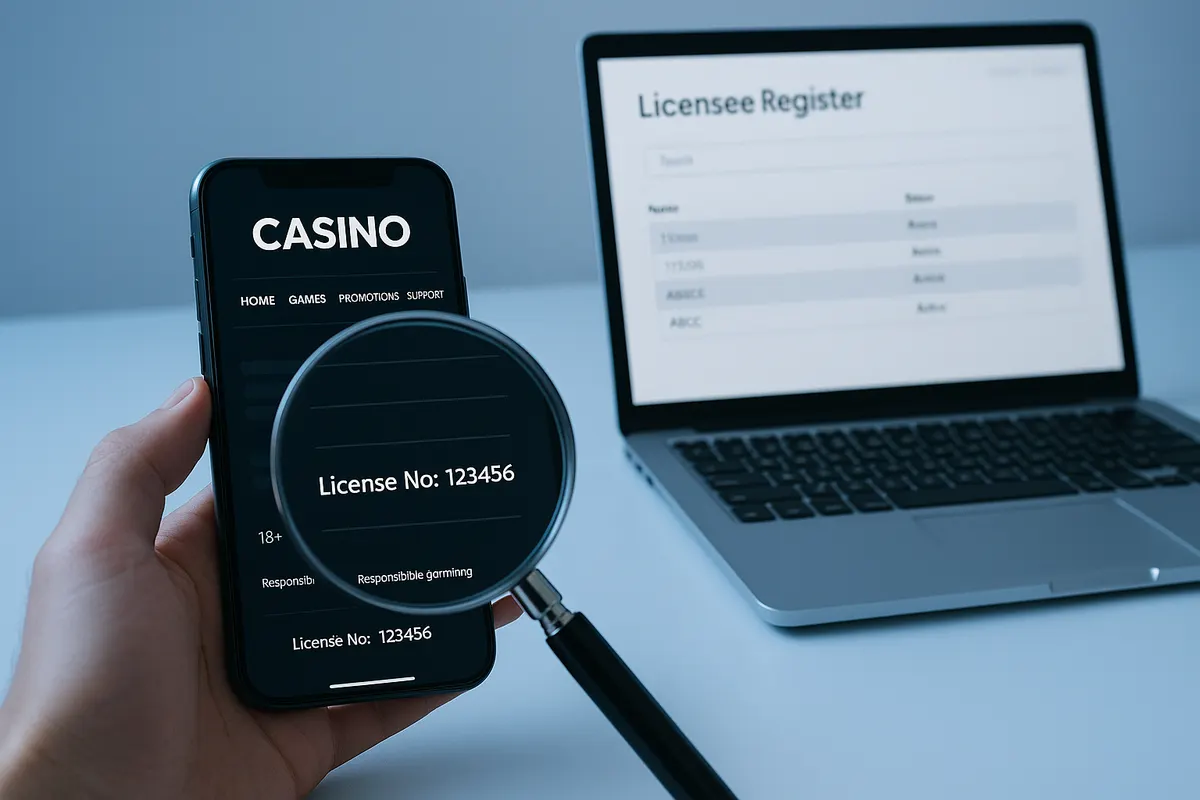
- Find the license statement in the footer. A regulated site names the licensing authority, the licensed company (legal entity), its registered address and a license or reference number. Vague wording like “licensed and regulated internationally” or a certificate image with no number attached is not a license statement.
- Go to the regulator’s own website and search its register. Type the authority’s address into your browser yourself rather than clicking the casino’s badge — badges can be plain images. Serious authorities publish a searchable list of licensees, including the UK Gambling Commission and the Malta Gaming Authority. Others commonly seen include Gibraltar, the Isle of Man, Curaçao and Kahnawake, with widely differing levels of oversight.
- Match three things, not one. The company name on the site must match the register entry, the license number must match, and the brand or domain you are on should be listed under that license. A real license held by a different company, or covering a different website, is the most common trick.
- Check the license status and scope. Registers show whether a license is active, suspended, surrendered or revoked, and which activities it covers. A live casino license does not cover sports betting, and an expired license covers nothing.
- Look for independent testing certificates. Game and RNG testing houses such as eCOGRA, GLI and iTech Labs issue certificates for specific operators and games. Treat the certificate as a supporting signal and verify it with the lab if you can; a logo on its own proves nothing.
- Read the terms that touch your money. Withdrawal limits, bonus wagering requirements, game weighting, max bet while a bonus is active and dormant-account fees. A 30x wagering requirement on a ₹1,000 bonus means ₹30,000 must be staked before any withdrawal — that is normal in regulated markets, and it should be stated plainly.
Red flags that point to a black market operator
Any single item below can have an innocent explanation. Two or three together is enough to walk away.
- No license number, no named company, no registered address — or a footer that names a regulator but nothing else.
- The license number does not appear in the regulator’s register, or belongs to a different brand.
- Bonuses that are wildly out of line with the market, especially huge no-deposit offers with terms buried or missing.
- Terms that change without notice, or that reserve the right to void winnings at the operator’s “sole discretion” without stated grounds.
- Deposits through personal UPI IDs, individual bank accounts or rotating payment links rather than a named merchant.
- KYC demanded only at withdrawal, then repeatedly reset with new document requests.
- Support that is chat-only, slow, scripted, or disappears once you raise a payout problem.
- No deposit limits, no self-exclusion, no visible responsible gambling page.
- Aggressive promotion through unsolicited messages, cashback-for-referrals schemes or influencer links with no advertising disclosure — the pattern behind the EU report’s 91% exposure finding.
- Mirror domains that change every few weeks, usually a sign the operator is being blocked or dropped by processors.
What a legitimate licensed site looks like
Positive signals are the mirror image of the red flags. A licensed casino names the entity that holds the license and the authority that issued it, and the details survive a check against the register. Its terms are dated, specific and readable, with wagering requirements, payout timeframes and identity verification rules stated before you deposit rather than after you win.
Look for game providers you can verify independently, published RTP information on slots, and a complaints page that names the independent body you can escalate to. Payment methods should run through named merchants with consistent processing times, and withdrawals should use the same channel as deposits. Responsible gambling tools should be in the account settings, not just described in a policy page: deposit and loss limits, session reminders, cool-off and self-exclusion.
One more habit worth keeping: check your own jurisdiction’s rules before you play, because a license issued in Malta or Curaçao says nothing about whether an operator is permitted to serve you where you live. In India the position differs between states and has been shifting, so the legality question sits alongside the licensing question rather than being answered by it.
Frequently asked questions
How do I check if a casino is licensed?
Find the license number and company name in the site footer, then search for both in the issuing authority’s public register on the regulator’s own website. The company name, license number and the brand or domain all have to match, and the license must be active.
What makes a gambling site regulated?
Holding a license from a gaming authority for the market it serves, and operating under that authority’s conditions: fund segregation, tested RNG and disclosed RTP, KYC and anti-money-laundering procedures, advertising limits, responsible gambling tools and a complaints route that ends with an independent body.
Why should I avoid unregulated casinos?
Because every protection that makes a dispute winnable is missing. Your balance is not ring-fenced, game fairness cannot be verified, nobody can compel a payout, and self-exclusion is not enforced. The EU study’s figures show how much money already sits in that space — EUR 91.6 billion of unregulated GGR in 2025.
Is a Curaçao or Malta license good enough?
They are real licenses with real registers, but the depth of supervision, the dispute-resolution route and the enforcement record vary a lot between authorities. Verify the license first, then judge the regulator by what it actually requires of operators and what recourse it gives you.
Gambling has a built-in house edge and loses money over time for players as a group. Licensing does not change that math; it only decides whether the game you are playing is the one advertised and whether anyone has to answer when something goes wrong. Set a deposit limit before you start, treat any spend as entertainment money, and if it stops feeling like that, use the self-exclusion tools or contact a support service in your area.