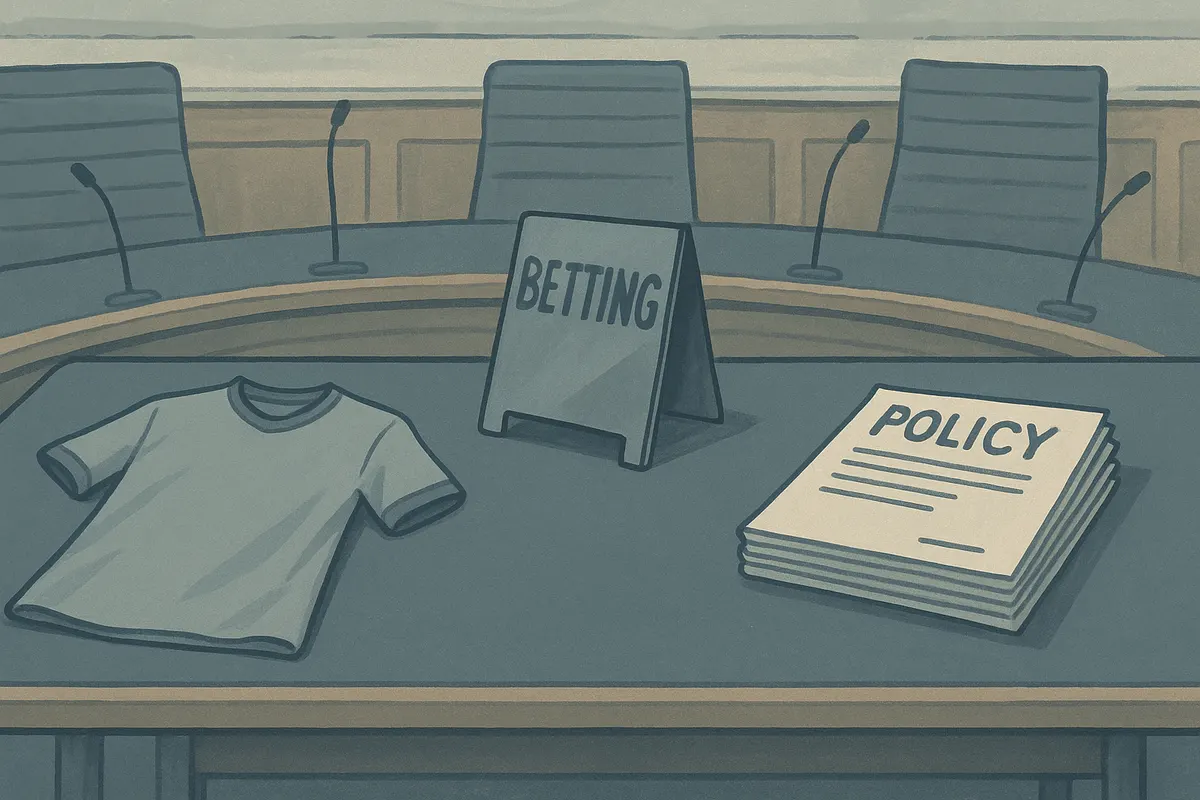
What the betting industry advertising debate is really about
The betting industry advertising debate comes down to one question: is gambling marketing harmful enough to justify restricting how a legal, licensed product is promoted? That’s the clean version. The messy version is that almost nobody argues the question on those terms.
Instead, when a government floats an advertising ban, a sponsorship phase-out or a marketing tax, operators and their trade bodies usually reply with something else entirely: employment, supply chains, tax receipts, grassroots sport funding, and the risk of pushing customers to unlicensed sites. Those are all legitimate considerations. They are also, by design, arguments that shift the conversation away from harm and onto economics.
If you work in this industry, or you’re trying to forecast where a market is heading, the useful skill isn’t deciding who’s right. It’s learning to read the playbook quickly and judge which claims a regulator will actually accept. Here’s how to do that, step by step, with the UK as the working example.
Step one: recognise the standard response pattern
Industry pushback on advertising and marketing policy tends to follow a recognisable sequence, whatever the jurisdiction:
- Pre-emptive self-regulation. Before a statutory ban arrives, the sector offers a voluntary code. The UK’s whistle-to-whistle restriction on TV betting adverts around live sport, introduced by operators through their trade body in 2019, is the textbook case. So is the Premier League clubs’ collective agreement to drop front-of-shirt gambling sponsorship from the end of the 2025/26 season.
- Economic impact framing. Jobs, tax, supply chain, regional employment. Usually accompanied by commissioned economic impact assessment work.
- Community and sport dependency. Sponsorship money that flows to racing, football, darts, snooker and lower-league clubs is presented as a service the state would otherwise have to replace.
- Black market displacement. The warning that restricting licensed advertising hands visibility and customers to unlicensed operators who answer to nobody.
- Proportionality and evidence challenge. A request that regulators demonstrate a causal link between advertising exposure and gambling harm before acting.
Notice what’s missing: a defence of advertising volume on its own merits. Almost no operator argues publicly that more gambling adverts are good. The case is always instrumental, which tells you something about how the industry reads its own public standing.
Step two: pull the economic case apart
The economic argument is the load-bearing wall of most submissions. It’s also where the most careful reading pays off, because three quite different types of claim get bundled into one headline number.
Direct employment claims
Direct employment means people on an operator’s payroll: retail betting shop staff, trading and odds-compiling teams, customer support, compliance, technology, marketing. In the UK the retail estate matters disproportionately here, because betting shops employ people in high street locations across regions where comparable jobs are thinner on the ground. That geography is deliberate in the argument. A national headcount figure is abstract; a constituency-level figure lands with an MP.
When you see a direct employment claim, check whether it counts full-time equivalents or headcount, whether it includes part-time shop staff, and whether the projected losses assume shop closures that were already scheduled for commercial reasons.
Indirect and induced economic effects
Indirect jobs sit in the supply chain: game studios, payment providers, data and streaming suppliers, media agencies, affiliate businesses, stadium and broadcast services. Induced effects are the spending those workers do in the wider economy. Multiplier-based totals are standard practice in economic impact work across every sector, and they’re not illegitimate, but they inflate a number considerably compared with payroll alone.
The honest question for any advertising restriction is narrower than the headline: how much of that activity actually disappears if marketing is curtailed, rather than being reallocated? Media agencies lose gambling billings; they don’t necessarily lose the staff. Regulators have become noticeably better at asking that question.
Tax revenue arguments
Tax claims cover general betting duty, remote gaming duty, machine games duty, corporation tax, employer national insurance and business rates on the retail estate. In Britain there’s an extra thread: horserace betting levy income, which funds prize money, integrity and welfare in British racing. Racing bodies therefore appear as independent voices making an argument that overlaps heavily with the operators’. That independence is genuine and it’s also strategically valuable.
The counter-argument regulators hear from public health groups is that gambling tax receipts are partly funded by harmful play, and that harm carries its own costs to health services, welfare and the justice system. Treasury departments rarely resolve that tension in public.
| Claim type | What it asserts | What to check before you accept it |
|---|---|---|
| Direct jobs | Payroll roles lost if restrictions bite | FTE vs headcount; closures already planned; retail vs online split |
| Indirect and induced jobs | Supply chain and wider spending effects | Multiplier used; whether the activity is lost or just reallocated |
| Tax contribution | Duty, corporation tax, rates, levy income | Gross vs net of harm-related public costs; duty rate changes assumed |
| Sponsorship funding | Sport and media income that would vanish | Whether other sectors would bid for the same inventory |
| Black market risk | Customers migrate to unlicensed sites | Channelisation data from comparable markets, not projections alone |
Step three: test the community and sponsorship defence
The community argument reframes commercial marketing spend as public benefit. Sponsorship of football clubs, racecourses, darts and snooker events is presented as money that keeps fixtures viable, funds academies and supports clubs outside the top flight. Operators also point to grassroots programmes, community foundations and their own funding of research, education and treatment.
The mechanism matters more than the sentiment. Two versions of this argument exist, and they are not equally strong:
- Dependency. A specific sport or league derives a large share of income from gambling sponsorship and has no obvious substitute buyer. British racing’s relationship with betting is the clearest example anywhere in the world, because the sport’s commercial model is built around wagering.
- Substitutable spend. A shirt or hoarding that another sector would happily buy at a similar price. Here the loss is to the operator’s reach, not to the sport’s balance sheet, and regulators increasingly say so.
The Premier League’s voluntary front-of-shirt withdrawal is instructive. Clubs kept sleeve and other sponsorship categories, which suggests the parties themselves saw the front of a shirt as negotiable rather than existential.
Step four: follow the process, not just the press release
Arguments only count where the framework lets them count. In the UK, that means a fairly predictable path: a government review or white paper, formal consultation by the Department for Culture, Media and Sport or the Gambling Commission, written evidence from operators, trade bodies, charities, clinicians and academics, then rulemaking, licence condition changes or advertising code amendments via the ASA and CAP.
Three things determine whether an economic submission moves the needle:
- Whether the consultation asked. If a consultation is scoped around harm reduction and player protection, an employment argument is technically out of scope and gets logged rather than weighed.
- Who else says it. Independent voices with aligned interests, racing, media owners, sports bodies, land-based venue operators, carry more weight than the same claim in an operator’s own submission.
- Evidence quality. Commissioned impact reports are read with the sponsor’s name in mind. Regulators tend to trust market data on channelisation and licensed-market share more than modelled forecasts.
The 2023 UK white paper is a useful marker. It moved decisively on stake limits for online slots, affordability checks and a statutory levy for research, education and treatment, while leaving advertising largely to voluntary codes and existing content rules. Whether you read that as successful advocacy or as a government reluctant to legislate on speech, the outcome was the same: economic arguments held the line on advertising and did not hold it on product controls.
Step five: check the global pattern before you judge your own market
The same arguments appear almost word for word in other jurisdictions, with very different results.
- Italy passed a broad advertising and sponsorship ban through the 2018 Dignity Decree. Economic and sport-funding objections were loud and did not prevent it.
- Spain tightened rules through royal decree, pushing TV advertising into a narrow overnight window and cutting back sports sponsorship.
- The Netherlands banned untargeted gambling advertising in 2023 and phased out sponsorship afterwards, with operators warning about channelisation to unlicensed sites.
- Belgium introduced a near-total advertising ban with a longer runway for sports sponsorship, giving clubs time to replace income.
- Australia ran a parliamentary inquiry that recommended a phased comprehensive ban on gambling advertising; broadcasters and sporting codes joined operators in resisting it, and the policy response stretched out over years.
The pattern is worth stating plainly: where advertising bans have been driven by a governing party’s political commitment, economic arguments have delayed and softened them rather than stopped them. Where policy was still open, those arguments have sometimes kept statutory bans off the table in favour of voluntary codes.
Do these arguments actually work?
Partially, and in a specific way. Their strongest effect is on scope and timing: longer transition periods, carve-outs for racing, sponsorship phase-outs instead of immediate prohibition, voluntary codes accepted in place of legislation. Their weakest effect is on direction. Once gambling advertising becomes a mainstream political issue rather than a technical one, employment and tax figures rarely reverse the trajectory.
Four factors seem to decide outcomes. Whether an independent coalition exists beyond the operators. Whether the country has a domestic sport with a real dependency on betting money. Whether the government has already committed publicly to restrictions. And whether the market can show credible channelisation data, because the black market warning is the one industry argument regulators consistently treat as a genuine policy risk rather than special pleading.
Quick answers
How does the betting industry defend advertising?
Mainly through economic impact claims (jobs, supply chain, tax), sport and community sponsorship dependency, warnings about unlicensed market growth, and offers of voluntary codes as an alternative to legislation.
What are the main arguments against gambling ad bans?
That restrictions cost employment and tax revenue, remove funding that sport and media rely on, and reduce the licensed sector’s visibility relative to unlicensed operators, without proven benefit to harm reduction.
Why do betting companies oppose restrictions on advertising?
Advertising drives customer acquisition in a market where switching costs are low. Restrictions compress growth and tend to favour incumbents with existing brand recognition, which is why positions within the sector are not always identical.
How do gambling regulation debates work in practice?
Through formal consultation on a defined scope, written and oral evidence from stakeholders, and rulemaking via licence conditions, statutory instruments or advertising codes. Arguments outside the consultation’s scope carry little weight, however well argued.
One closing note, since this is a debate about marketing aimed at real people: gambling products carry a built-in house edge and produce losses over time for players as a group. If your own play has stopped feeling like entertainment, deposit and loss limits, cool-off periods and self-exclusion are available at every licensed operator, and free confidential support is offered by GambleAware.